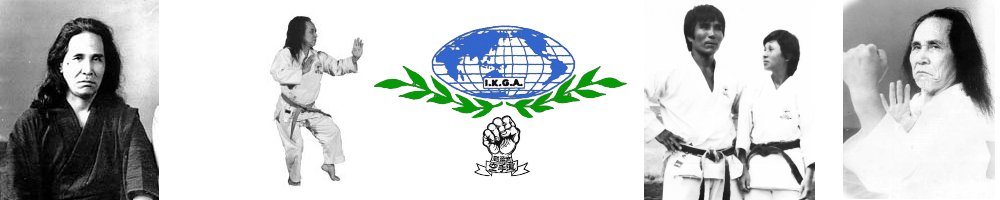

Goju Kai Karate Do Sydney Australia - Archived
HISTORY FOR BEGINNING STUDENTS
Page 1.
Page 2.
The characteristics of Goju-Ryu can be divided into four main categories:
2.The principle Yo ("Go") and Yin ("Ju"): The techniques of Goju-Ryu are based on the infinite combinations of "Go" (strength) and "Ju" (softness). One
can use the circular movements of "Ju" to counter the "Go" attacks and swiftly fight back with "Go".
3." Jiyu Kumite" (Free Fight / Combat) suited to close range combat: The "Kumite" (the practice in free style combat) of Goju-Ryu is suited to close
range combat using the "Nekoashi-Dachi" (The Cat Stance) for unrestricted movement and successive multiple attacks.
4. The philosophy of "Buji" (absence of conflict or peace): The philosophy behind Goju-Ryu is demonstrated in Master Chojun Miyagi's words "Not to be
hit / attacked or hit / attack, the absence of conflict is the essence".
All Japan Karate-Do Goju-Kai continues passing down these traditions as well as actively promoting Karate-Do as a modern competition sport by
participating in tournaments worldwide, gaining recognition for admirable results.
SOURCE : I.K.G.A. Program World Titles 1993
MASTER KANRYO HIGASHIONNA
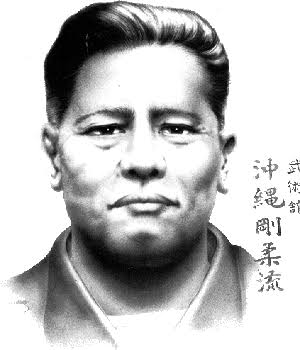
CHOJUN MIYAGI (1888-1953)
Page 1.
Page 2.
Pictured above is Chojun Miyagi the founder of the Goju-Ryu or Goju school which is one of four major schools of Karate-Do with a proud history and tradition. The founder of Goju-Ryu, Master Chojun Miyagi (1888-1953) entrusted the teaching of Goju-Ryu in mainland Japan to Master Gogen Yamaguchi (1909-1989). Master Gogen Yamaguchi founded All Japan Karate-Do Goju-Kai in 1950 and promoted Goju-Kai throughout the world.Along with our new president of Goju-Kai, Master Goshi Yamaguchi, all the members of Goju-Kai worldwide are working as one to pursue and contribute to the development of Karate-Do.
The characteristics of Goju-Ryu can be divided into four main categories:
1.
Breathing Techniques ("Ibuki"): To consciously
control breathing to unite the mind and body,
activate the internal organs and to reach a state
of
total awareness.
total awareness.
2.The principle Yo ("Go") and Yin ("Ju"): The techniques of Goju-Ryu are based on the infinite combinations of "Go" (strength) and "Ju" (softness). One
can use the circular movements of "Ju" to counter the "Go" attacks and swiftly fight back with "Go".
3." Jiyu Kumite" (Free Fight / Combat) suited to close range combat: The "Kumite" (the practice in free style combat) of Goju-Ryu is suited to close
range combat using the "Nekoashi-Dachi" (The Cat Stance) for unrestricted movement and successive multiple attacks.
4. The philosophy of "Buji" (absence of conflict or peace): The philosophy behind Goju-Ryu is demonstrated in Master Chojun Miyagi's words "Not to be
hit / attacked or hit / attack, the absence of conflict is the essence".
All Japan Karate-Do Goju-Kai continues passing down these traditions as well as actively promoting Karate-Do as a modern competition sport by
participating in tournaments worldwide, gaining recognition for admirable results.
SOURCE : I.K.G.A. Program World Titles 1993
MASTER KANRYO HIGASHIONNA
The history of Goju Ryu can be traced
back to a man named Master Kanryo Higashionna,
approx 1840-1910, known as the "Fist Saint of
Naha". Naha city in Okinawa was thriving with
martial arts activity in the 1850's. Along with
practitioners from the towns of tomari and Shuri,
the Naha karateka were laying the groundwork for
the development of modern karate-do and kobudo
(weaponry). But although Higashionna Kanryo began
his training here, the true seeds of Goju were not
planted in Okinawa but rather in China.
Higashionna Kanryo went to China and studied
there under a man by the name of Master Woo (Ru in
Japanese), who was a practitioner of Chinese
boxing. Kanryo Higashionna then trained under
Master Woo for approximately 15 to 20 years. On
his return to Okinawa he combined his native
fighting system with the Chinese system and became
the father of Naha-te (Fist of Naha). It didn't
take long before his fame spread throughout the
island and students started to come to him for
tuition. Among them was a student by the name of
Chojun Miyagi.
CHOJUN MIYAGI (1888-1953)
Chojun Miyagi was born in Naha as the
son of a wealthy businessman on April 25, 1888.
Miyagi Chojun then began his study in karate
between the ages of nine and eleven years . In his
early teens he became the student of Master Kanryo
Higashionna. Under the tutelage of his Master,
Miyagi underwent a very long and arduous period of
training. After the death of Master Kanryo
Higashionna, Miyagi Chojun then travelled to the
Fukien Province in China as his teacher had done
before him. In China he studied the shaolin and pa
kua forms of Chinese Boxing. From the blending of
these systems, -one the hard/external form of
shaolin, the other the soft circular/internal form
of pa kua and his native Naha-te a new system
emerged. However, it was not until 1929 that
Chojun Miyagi named the system Goju Ryu, meaning
hard soft style. The name was inspired by the
`eight precepts' of traditional Chinese Boxing,
quote: Everything in the universe breathes out
(hard) and in (soft) ... etc. After some years in
China, Chojun Miyagi returned to Naha where he
opened a dojo (training hall). He taught for many
years, and even though Miyagi Sensei's reputation
as a man of Karate do was enormous, his greatest
achievements lie in the organization of Karate-do
teaching methods. He introduced karate-do into
schools and other fields of society. He developed
Kata Sanchin - the hard aspect of Goju Ryu, and
created Kata Tensho - the soft aspect. These kata
are considered to be the essence of the Goju
style. Chojun Miyagi was a man of extremely mild
temperament and it is said that he was a very
humble man. He lived according to the principles
of Martial Art's, that of none violence. Master
Miyagi died on Okinawa on October 8, 1953.

© 2023 GOJUKAI.COM.AU

.
Goju-Kai Karate-Do 2023