Alexandra Starling Shihan
師範

Photo Graphics- Courtesy of Eugene
Kitney Sensei.
WORLD UNION OF
KARATE-DO ORGANISATIONS-WUKO WORLD KARATE-DO CHAMPIONSHIPS

Bronze Medalist
1982-
TAIWAN. ROC
1st-Japan-[Mie Nakayama]
Sandie
Alexandra
Starling & Goshi Yamaguchi Shihan in Sydney
1980
Alexandra Starling 5th
Dan Renshi Shihan, known as Sandie, was the
first Australian to win a place in an
internationally recognised
World
Karate do Championship. She was also the first
Australian woman to receive a Black Belt
in the New South Wales branch of the Australian
Karate Federation (A.K.F.) and the first in New
South wales to gain referee/judge status after
her dear friend and senpai; Kora
Nowak Shihan -Shotokan; LINK
1 who
had immigrated from Germany LINK 2 . In
the International Goju Kai Association
Sandie was also the first non-Japanese
woman to be graded to Shihan (Master rank) &
5th Dan [1989] , by the world renown goju-ryu
master Gōgen Yamaguchi (山口剛玄) Kaiso. Over 60
Nations were represented from throughout the
World at the 6th World Karate Championships in
1982 with Mrs Starling being the oldest
competitor in the tournament , then aged 33yrs.
In the final round of the Kata competition she
gained a higher score from the Japanese judge
than the eventual winner- Mie Nakayama , and was
awarded a Bronze medal for Australia. Mie
Nakayama represented Japan .
Alexandra
retired
from
competition
after the World Tournament in 1982, her first and
only attempt at an International event. She then
went on to become the first female coach on a
state/national level, and trained a large group of
state and national champions as well as
International competitors until 1989. The majority
of her teaching has been confined to traditional
Goju Ryu rather than tournament style. During those
early days of tournament competitions in Australia
there were very few women training in Karate do ,
and it wasn't until the 1980's that women were
permitted to compete and by that time Sandie was
already in her early to mid thirties. Some of her
accomplishments from that era are listed below:
Australian Champion-1982-Female Kata
event.
Australian Kata Medalist 1978-1982
New South Wales Kata Champion 1978,
New South Wales Kata Champion 1979,
New South Wales Kata Champion
1980,
New South Wales Kata Champion 1981,
New South Wales Kata Champion 1982.
New South Wales Kumite Champion u/53k,
1980
Australian Female Kumite Finalist
Silver Medalist
Australian Karate Federation-
Formerly FAKO Australia's only recognised
body for Karatedo
Australian Team Member & women's captain.
1982
Inaugral Member of the Kokusai Karate do Shihan Kai

Sandie
commenced training in February 1974 at the North Sydney
Dojo and Macquarie Iniversity Karate Club in Sydney
where she was first introduced to her husband Paul.
Training on a full time basis 6 days a week and 4 hours
per day,( and 6 hours on Saturdays), she persisted with
this punishing regime and became very proficient
over a period of 4 years culminating in her gaining full
Shodan status in December of 1977. In those days classes
were jam packed with baby boomers who had witnessed the
prowess of the reknown Bruce Lee via his many movies,
and it was not uncommon to be training alongside 60 to
80 other students each night, the majority 99.9% of whom
were male. Not only was it practically unheard of in
those days for an Australian woman to gain a Black Belt
in Karate do (there were two in Victoria and one or two
in Judo) and none in New South Wales; it was also a
period when women were NOT permitted to compete in
Karate Tournaments in any form , Kata nor Kumite.

Because Sandie
Shihan had gained Black Belt status she was invited to
participate in the Australian Karate Federation meetings
whereby she argued vehemently for a women's division in
tournaments to be introduced. This was approved by
1978 however only Kata events were permitted initially,
in line with the (WUKO WKF) World Karate Federation
ruling. Initially having no interest in Kata competition
Sandie was particularly interested in competing in Jiu
Kumite events as opposed to point Shiai kumite which was
not taught at her dojo, all students being required to
perform strongly instead in free sparring round
robin sessions often lasting up to 2 hours per session.
Because Sandie was mainly partnered with men her forte
was in this area rather than in the execution of
competition Kata. After competing and winning the
inaugral tournament though, it was as the first New
South Wales female Kata Champion that Sandie forged
ahead determined to improve to the point where she might
one day gain the Australian Kata Championship title.
Traveling to the World Karate Championship in Longbeach
California in 1976, then on to Japan to train at the
Honbu Dojo of Grandmaster Gōgen
Yamaguchi and his son Yamaguchi Gōshi
Shihan, she trained in private sessions with
Wakako Yamaguchi Shihan daughter of Gogen and sister to
Goshi Yamaguchi Shihan. She trained again with Wakako
and Goshi Yamaguchi Shihans after they had travelled to
Australia for Summer Camps at Tallangatta ( held by
Victorian Goju Kai) and later stayed with Paul and
Sandie at their home nearby to Macquarie University.

After
experiencing Wakako Shihan's incredible technical
ability it was Sandie's aim to emulate Ms Yamaguchi's
performance in the higher Kata; training rigorously on a
daily basis it was from 1978 through to 1982
Sandie remained the undefeated Kata Champion and was
also undefeated as Australian Champion having
retired from competition in 1982 after her World
Championship medal performance in Taipei Taiwan.
Although going on to coach many champions both male and
female in State National and International competition,
it was still traditional Japanese Goju Ryu training that
meant the most to her so she took every opportunity to
train in Japan with the Yamaguchi family, at the Dojo of
Gogen Yamaguchi Kaiso, Goshi Yamaguchi Hanshi, Gosen
Yamaguchi Kyoshi and Wakako Yamaguchi Shihan. At
the same time Sandie was invited to train with many
famous Karate masters by their Australian Chief
Instructors, including: Morio Higaonna Sensei from
Okinawan Goju Ryu whenever he was in Australia: Hirokazu
Kanazawa Hanshi from Shotokan on many occasions, Suzuki
Hanshi from Wado Ryu, Kenshu Watanabe Shihan, Frank
Nowak Shihan, Phillip and Robert Kear Shihan and Tino
Ceberano Shihan as well as Inoue Motokatsu Kaiso from
Ryukyu Kobujutsu Hozon Shinko Kai.
B.A. Modern History
M.A. Modern History
Macquarie University Sydney Australia
Qualifications
5th
Dan Renshi Shihan 1989
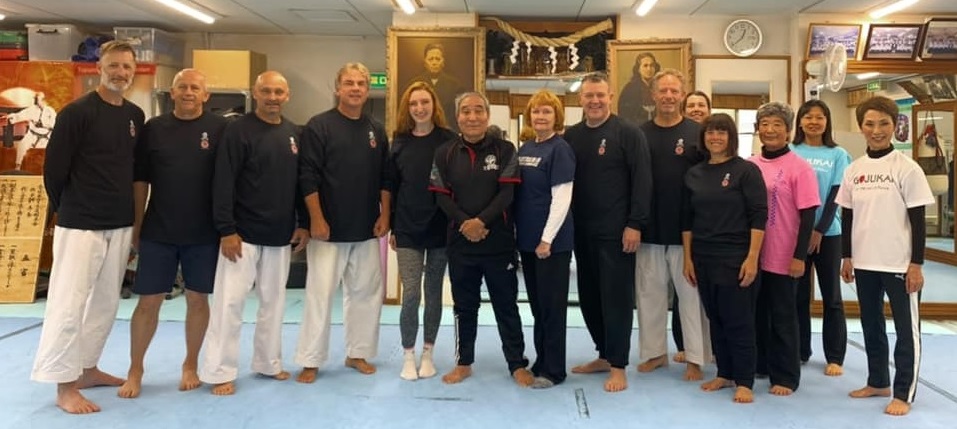
Honbu Dojo Suginami Ku November 2019 Sandie
Starling & daughter Alexandra Paula Starling
deceased -1993-2024-
with Goshi Yamaguchi Hanshi ; Horden Wiltshire
Shihan ; & Sydney Dojo & Honbu Dojo
members.


